

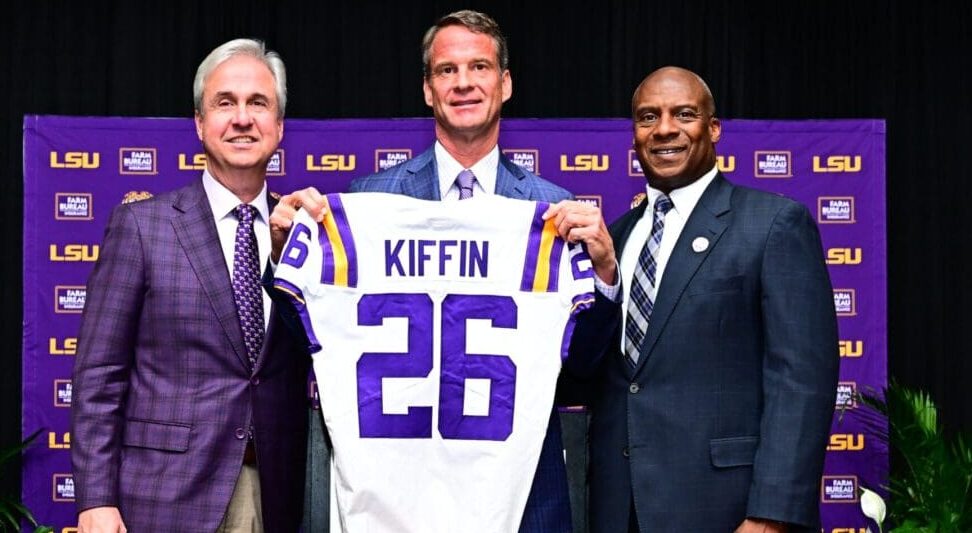
LSU Football – Lane Kiffin Introductory Press Conference
Monday, December 1, 2025
Baton Rouge, Louisiana, USA
Head Coach Lane Kiffin
LSU President Dr. Wade Rousse
Athletic Director Verge Ausberry
Weekday Press Conference
DR. WADE ROUSSE: What an exciting time. For the first time in my remarks I feel like I need to begin my remarks instead of ending my remarks with as we always say, Geaux Tigers.
It is an exciting time. I was looking for our guy there. It is an exciting time. We’re so excited to be here. What a wonderful day for Louisiana and this LSU family.
Today, today our family is growing, and we could not be more excited to welcome Layla, Landry, Presley, Knox, and our football coach, Coach Kiffin. Welcome to this Tiger family.
Let me begin with a few words of deep gratitude for every member of LSU’s athletic and executive staff who have dedicated long hours and time away from their families over the holiday weekend to make this moment a reality. Thank you so much for your time.
I also want to give a little special thank you to Board Chairman Scott Ballard, Athletics Committee Chair John Carmouche, and all of the members of the Board of Supervisors who have engaged, who have supported, and who have helped to ensure that we have all of the resources in place to restore a championship culture right here in Tiger Stadium.
While Coach is certainly the man of the hour, I would be remiss — I would be remiss if I did not save my final message of appreciation to someone who has given decades of his life to this athletics department, to a leader who truly embodies what it means to be an LSU Tiger.
Just a few short weeks ago in my first meeting with our Athletic Director I talked a great deal about the need for structure, accountability, and measuring ourselves against only the best. Our Athletic Director responded by telling me he would be accountable for finding the best football coach in America.
Verge, you are a man of your word, and you have certainly delivered on that promise today.
Ladies and gentlemen, please join me in a round of applause and welcome to this podium the architect of today’s announcement, LSU’s Athletic Director, Mr. Verge Ausberry.
(Applause)
VERGE AUSBERRY: What a great day to be a Tiger, a beautiful day. I want to thank President Rousse and our Board of Supervisors and our governor for the commitment to making sure we got the coach we needed.
I also want to thank Ms. Julie Cromer and the search committee for the long hours the past couple of weeks in making sure we got this done and done the right way for Louisiana.
Julie has been My All-Star. She in the room tonight? She’s here? Julie likes to stay in the background, but she’s very, very important to this process in helping us get Coach Kiffin here.
I can honestly tell you from the moment we determined that a coaching change would be necessary, the first name on everyone’s lips was Lane Kiffin. There are a lot of great coaches out there, and we performed due diligence on several other candidates, but the name none of us could shake was Lane.
LSU football has a unique place in the history of the game, in the traditions of the SEC and the hearts of everyone with any connection to the state of Louisiana. Purple and gold have always represented something special. It represented Death Valley on a Saturday night. It represents some historic offenses and stifling defenses, as well as championships in excellence. That word “excellence” is LSU.
Our colors in the stadium tell anyone in the world that they are watching LSU. As a former player and an administrator here for the last nearly 30 years, I can tell you that when the band strikes up Hold That Tiger, there’s no better place in the world to be.
So when we realized it was time to replace our head football coach, we knew we had to find someone who could get it, who would understand tradition, personality, culture, and who could contribute to both our history and to our future.
Immediately Lane Kiffin became our prime target. He was not only an offensive innovator, energizer, and winner, he is also a program builder, a brilliant recruiter, in the most competitive conference in America, and a big enough personality to operate in a state of big personalities.
In a program in a state that challenges some, we believe Lane wouldn’t blink. We believed he could thrive. I’m not going to tell you the road for getting him here didn’t have some unique challenges, but I will say those challenges came from the right reasons.
Lane was running a championship contending team. He loves his players, and he wanted to do the right thing for his family. I admire all of those reasons, and it made me want him more.
We believed that LSU is the place he may be willing to come. We believed it would be a perfect fit for someone like him. We told Lane that LSU was not just a place to come to win games. He has done that already. We told him it was a place to come to contend for national championships year in and year out.
We promised him the resources to recruit and develop the best players in the country. We promised him a student body and a fan base that demands success, and we promised him a state and a community that will welcome him and his family and that was eager to become, with his leadership, legendary.
If those sound like big promises, then you don’t know how much I love and believe in LSU and Louisiana. We asked him to believe too. He showed us he was all in.
I could read you his résumé, but you probably already know it. I could tell you more about his personality, but you probably are familiar with that too. I could tell you he has the presence and energy to make everyone he works with feel a winning attitude, but I know you will find that out soon enough.
I can’t wait to get down to work with Lane. Lane, the promise to get you here hasn’t always been the most predictable, but I believe you will find it to be home you’ve been looking for. We want to welcome you and your family to LSU, to Baton Rouge, and the state of Louisiana. Geaux Tigers.
(Applause)
LANE KIFFIN: First off, I want to thank my family for all their love and support throughout this process. Layla, Knox, Landry, Presley, my children, brother Chris that’s here with his family. Thank you for all the support through this process, which was not an easy one.
I would also like to thank President Wade Rousse, Athletic Director Verge Ausberry, Board of Supervisors chair Scott Ballard, athletic board chair John Carmouche, and Julie Cromer.
I also had a unique great call with Governor Landry, and I could feel his passion and energy in that call for the state of Louisiana and for LSU football.
Also, the people that reached out to me through the process from former great, great LSU players and very powerful LSU alumni, I’m very honored to be the head coach of LSU.
I can sum it up by saying this: this place is different. Having watched this place for a long time, having been on the other sidelines in this stadium, this place is different, and that’s why we’re here. We have a lot of work to do with that, but I’m very grateful for the opportunity to lead one of the elite programs in all of sports.
Leaving Ole Miss was extremely difficult. Extremely difficult decision. In that, we tried every single thing possible to continue to coach the team through the playoffs and to continue to coach the players. In the end that was their decision, and we totally respect that and appreciate the time and energy that we tried to figure out a plan to do the best thing at the time for those players.
The last six years of my life have been the best six years of my life, and I owe that to all the players, all the assistant coaches and the people of Oxford. It was amazing. It will forever be a major part of my story. I’m so grateful for those relationships and all of those people that I got to meet, but the opportunity at LSU, as I said before, is just different.
Someone very close to me reminded me this week in this decision that LSU is the best job in football. When you take the history, tradition, passion, and the great players in the state of Louisiana, no one can argue that when you’re in Tiger Stadium on Saturday night, there is nothing like it.
This place is built for championships with championship expectations. We understand that, but as an elite competitor, that’s exactly what you want, and that’s why we’re here, you know, over the past few weeks and especially the last few days trying to figure out this decision, and I really tried to channel my dad, and I thought of when I spoke at his funeral.
When I spoke, it occurred to me as I was writing that speech, I never understood why as a kid we moved so much, and I realized he had moved 17 times. During that funeral and during that week when he passed, the amount of people that reached out to me that were either at the funeral, wrote letters, wrote notes to me, found my number, texted me, was amazing from all the different places that he went.
It became apparent to me, and I spoke on that, that happened for a reason. He went to all of those different places for a reason. He didn’t stay one place. He went to all those places so he could connect with all those people, impact all those people, be impacted by all those people at the different places.
As I thought about that, even with the best six years, it became apparent to me what the decision was. My journey has been unique, to say the least, but I believe everything that I’ve been through has prepared me for this moment at this place right now. I also believe everything happened exactly how it was supposed to happen, when it was supposed to happen. That will be clear someday that all of it did.
Our program here at LSU will be designed top to bottom to be the No. 1 destination for elite players in all of America. That’s why we’re here. Our immediate priority is assembling the best staff in the country and securing top talent.
The mission is simple: bring the best players in the country to LSU, and it starts right here in the state of Louisiana. To win big, as you go through this decision and you look at different places and all of the things evolve, to win big, you need everybody pulling in the same direction, and I felt like this process that definitely the leadership here at LSU was all aligned and all in place to give us that.
I know that we have, with the passion of LSU family and our LSU players, that we have everything to bring championship football back to LSU. It’s time for LSU to take its place back as the best program in all of college football, and that’s what we’re here to do.
So thanks for everybody showing up. Thank you for believing in me. Let’s go to work, and Geaux Tigers.
(Applause)
LANE KIFFIN: I appreciate that. Questions.
Q. Can you talk about how happy you were at Ole Miss — (off microphone). What drew you away from that?
LANE KIFFIN: Yeah, great first question. That was, as I referred to, that was excruciating and difficult. Like I said, we tried every possible thing for a long time the other night and into the morning as you saw the team meeting announcement get pushed back because we were trying to get that done.
, and I’m very grateful for the chancellor there in Keith Carter, you know, that they listened. We presented a plan how that could be done and give the players the best chance to win in the playoffs, and at the end of the day, that’s their decision, and I respect that.
Made a good point. That may make sense to everybody outside, why the best thing was to keep us all together for the playoffs. It may make sense to all the national media why that made sense to do that. Like he said, he has to live there, and I totally respect that and I respect their decision, and so appreciative for them.
Q. Verge talked about your résumé. I guess just why do you feel like you’ve been successful over the last handful of years in this ever-evolving college football landscape?
LANE KIFFIN: Yeah, I think we’ve been very successful because we’ve had great players. We’ve been very successful because we’ve hired great assistants that fit together.
I think that college football has changed a lot over the years, and I think that a thing that we do extremely well is we don’t just think outside the box. We create a new box.
The way that we do things is not traditional, and just because in the book of coaching this is how we do it or it was done that way before, we’re always looking for new ideas trying to figure things out. That started years ago with the innovative offense and changing the style of offense that we played over the years, having a unique offense that I don’t feel like is anywhere else in America by the system that we have and how it’s run.
Then with that, you know, from high school and into the portal recruiting and embracing that and embracing the portal and figuring out a way to put the best collection of players together where we were at. I think the record shows we did a really good job of that.
Q. I’m wondering if there are things that you can share with your conversations with your mentors and whomever else you sought out to make this decision, what were some of the things they shared with you that sort of helped sway you one way or the other?
LANE KIFFIN: Yeah, I think that it was a really difficult decision. When you’re in those difficult decisions and you’re torn, very torn, back and forth, back and forth, and there’s multiple options, you know. There were really four different places that we had to think about in this. I just talked to them, and it really was apparent to I felt like everybody that I talked to outside of the state that I was in all basically said the same thing.
They all said, man, you are going to regret it if you don’t take the shot and you don’t go to LSU. It’s the best job in America with the best resources and to win it. It’s obviously been done here before by a number of people.
Pete Carroll, really he told me that he always told my dad that he would look out for me. When we were talking, he really channelled him from knowing him for so long, and he said, this is exactly what he would do. He would tell you, boy, go get it; go for it.
Coach Saban kind of coached at another place in this conference, so I can’t really say exactly what he said, but I’ll say I think the world of Coach Saban, and I respect him. So there’s a reason I’m here.
(Applause).
Q. Obviously you’re known as one of the top offensive minds in football, and I think for a long time people have tied that to the Briles offense. Over the years what have you changed, adapted that you would consider now the identity of what your offense is?
LANE KIFFIN: Yeah, I think that we have the most unique offense in the country, and because of learning from so many people along the way. We hired Art’s son Kendall at FAU and then learned a ton from the Briles family about offense and that whole system, and then really combined that over what we had done over the years, at USC, at different places, at Alabama, and then said, okay, what if we combine these two and take this up-tempo spread system, but then really still do it with problem plays, problem formations that — remember, I really grew up really under three people: My dad for my whole life, Monte Kiffin; then Pete Carroll; then Nick Saban. So really I basically spent the majority of my life with those three defensive minds.
Over time always listening to them, what gave them problems as three of the best defensive minds to ever coach this game, I mean, how blessed am I that I got to be around those three people. Then you think about, okay, combine all that they said and put this thing together.
It’s been a great offensive run because of that, and I’m not going to get up here and talk about individual numbers and stuff like that, but if you research them, I would say over the last, whatever, since we left Alabama, so that’s nine years, okay, if you take points yardage, that’s the No. 1 offense combined in all of college football.
Q. You mentioned it a little bit. What are your memories of coming here as an opponent playing in Tiger Stadium, and how do you feel now to have that arena in your corner as the head coach?
LANE KIFFIN: It feels good to be on that sideline. Been here a number of times. Now that you say it, I’ve been down there in what you guys have watched for a long time that I would say that you would probably say two of the most intense times and feelings, and those were two overtimes: one at Alabama here, and then one at Ole Miss here in the overtime two years ago.
Man, that feeling on the other sideline all the way from the warmups of those night games. Man, it is — I coached a lot of places, okay, and a lot of road games. NFL, College there is nothing like the feeling when you are on the other sideline and the intensity that you feel, it’s like a weight that you feel.
I talked to head coaches who have been here before obviously. They talk about feeling on the other sideline how they feel lifted up by the crowd in the intensity. Well, when you’re on the other sideline, you feel it the other way, and especially when you get into crunch time and overtime at night.
I felt that, and I always thought to myself, man, what if we had that advantage on our side? So if we combine what we do, the way that we coach players, the systems that we run, and now we have that intensity on our side for the opponent to deal with, again, that’s how all — it painted it all together to say, and this is where you are supposed to be.
Q. You mentioned some of the immediate needs you wanted addressed with the program. I’m wondering if you could talk about some of the people you might be bringing with you on this coaching staff offensively and just your thoughts on the defensive staff that’s already in place here?
LANE KIFFIN: Yeah, I think that’s a really good question. I don’t know that I can get into it. There are so many things I can’t even — what, have we been here for 24 hours? So I don’t know that all that is figured out and we’re still in the process. It’s a challenging spot, too, because LSU is still playing in a bowl game, too.
Frank will continue to serve in that role. We’ve spent a lot of time together in the last 24 hours as I’ve been here. Less than 24 hours. So have made the decision that he’s still going to stay this in that role as the head coach of that team for the bowl game.
There’s a lot of complicated moving parts in that, but we’ll definitely have that answer for you soon. Thank you.
Q. Is there anything that surprised you in this process with talking with Verge in the last few weeks or since you’ve been here, and is there anything specifically that you can share that Nick Saban told you in your phone conversation with him about this job?
LANE KIFFIN: Yeah, I just felt — and all respect to the other three programs. I just felt the passion through Verge, and obviously he’s in a unique spot as having been here so long and played here and been part of so many championships and been around so many championship coaches that I just felt that passion and I felt that alignment from everyone, from the President, from the Governor.
It became apparent that alignment of all being there, and other places have good alignment, but it was like the entire state of — everybody that I talked to at some point, okay, was aligned that the No. 1 thing in this state is to get LSU football back to the championship level where it was at before.
That’s very unique to have everyone in the state, okay, on the same page to get the same thing done. It’s pretty awesome. Again, it’s why we went through a really challenging time and a really difficult decision and a great place where we were at, and great support. To have to make the decision to leave there, okay, as over the six years there, a lot of opportunities to leave including in this conference, very prominent programs and never did.
It came down to at the end of the day the only one we were leaving for was once we he found this, once we felt this alignment and passion at LSU.
Q. You’ve talked I guess this season about how important reconnecting with your family has been and I guess the reported trip down to Baton Rouge a couple weeks ago, how important was it for your family to feel on board with this, and what were some of those conversations like with them over the past 24, 48 hours?
LANE KIFFIN: You know, as a football coach, it’s awesome in so many ways, but it’s very challenging when you make decisions versus probably what I would think most of you guys go through. Meaning you’re at this place that you really love and your family loves it and you’ve had this amazing six years.
These opportunities come, and it’s like, okay, are you going to come? You don’t really know anything except for the stadium at the places, because that’s really all you’ve ever been is in the stadium.
Then you, your family, your brother’s family, and his four kids are all going to move there, so I have to make this decision, but I have none of this information about what the neighborhoods are like, what the people are like, what the schools are like. I have none of it.
It’s not ideal, but it came down to, well, I’m not going to go as the head coach of a place to go, because even though most people do that, they spend a weekend somewhere in other professions and go to the schools and restaurants and get a feel for it, neighborhoods, and then they make a decision. Sometimes they take four months to relocate and stuff in the real world.
That doesn’t happen. You get on a plane and you go.
I just thought it was really important when they offered to have the family come down without me and get a feel for it. It was very important, because that went a lot into the decision. I don’t know that I could have made — I don’t know that I could have made the decision or certainly couldn’t have made it and felt good without everybody on board like it was after going to multiple places and coming back and saying, hey, we’re all in; we’re all in to go to Baton Rouge and to go to LSU.
Q. I’m curious, how much did an NIL plan in this new true third-party NIL era factor into your decision, and what can you share with us about the plan LSU laid out for you?
LANE KIFFIN: Yeah, great question. You know, when you talk about the four places and making the decision, I said through the process I’m never going to make a decision on money, and I’m telling you right now, I don’t know what my contract is here.
That’s not very financially responsible, okay? I’m sure it’s really good, okay? I don’t know what it is. Nor did I know at the other places what the numbers were. Because I said in the beginning — I told Jimmy Sexton, don’t tell me the numbers. I want to make a decision that has nothing to do with money for me.
Now, tell me the numbers and the plan for what the money is for the players, because that’s everything in that area to me. Not what I make. What they make to understand how can you build this? If you are going to make a change and you’re going to move and all these people are going to move and you’re going to do all this and go through that, which was a very challenging obviously last 24 hours and in a lot of ways sucked. It’s the only way I can describe it.
It sucked for a lot of people, and there was no way to possibly do it in my opinion any better than we did from a timing standpoint, because it’s a bad scheduling system of how it’s set up. Eventually hopefully it gets like the NFL where you can’t do that in the season and don’t have to make those decisions.
But in that, it was very important and very critical. Verge and his team had a really, really good plan and even talked to some donors that are part of that plan here to see exactly how does that work. There’s a great plan here. There’s a great plan of how we can come together with what we bring and what players around the country want to play for us and play in our systems and then have that support to be able to do that so that they want to play for us and they get taken care of financially.
Obviously nowadays it’s the world of college football, and it’s very important and critical to them, which it should be. This was the best setup. That definitely played a factor into it. Because I don’t care what your systems are, without good players, they don’t work.
I actually asked today about my contract. Not the numbers. I still don’t know them. I said, hey, just in case I get asked on it, and he said, basically all four were extremely similar contracts for me, but in the process of figuring out the NIL package, those were not similar; those were not the same. That’s a big part of it.
Q. How have you felt mentally and emotionally from the optics of having to leave Oxford to the boos to landing here to the cheers? How has that been for you in those aspects?
LANE KIFFIN: Time heals a lot of things, and having gone through in this conference before, I sure hope that happens. I sure hope that the people there and the fans there, as time goes, can focus on the amazing six years, the greatest football run in the history of the school, the greatest regular season ever in the history of the state just happened there.
I really hope they can focus on that. And where we were able, with the support of people there, where we were able to put the program on a national stage that it had never been at before and maintain it there for a number of years.
It was very hard and it was really challenging. It is, man, the passion of the SEC. So I understand that so I don’t get emotional with it yesterday like so many people get emotional, you know, like that. They change like that.
Because we spent six years there. That airport scene and Knox and I driving and people trying to run us off the road, man, and the things they said to us. Then we got here, and we had been here for six minutes and how we love you, Coach, you’re the best ever. We have only been here six minutes. We haven’t done anything for you yet.
But that’s the SEC. I’ve been around it long enough to know that, and it’s just the passion of the SEC. I’m not upset at those reactions by fans, by people. I think that people get really upset when you leave somewhere because they feel hurt because you’re doing a really good job.
They ain’t going to the airport and driving from all over, okay, to say those things and yell those things, okay, and try to run you off the road if you were doing bad.
I just look at it as passionate people in the SEC, and that it means that they really liked what we were doing there. Because the way the players played, because the way the assistant coaches coached and the performance we put out on the field is why we ended up in the situation we are having to decide from all these different places.
Q. You talked with Florida and you talked with LSU. What did Verge Ausberry say to you maybe the first time you talked to him that you thought, that’s exactly what I want to hear?
LANE KIFFIN: I’m going to leave you alone and let you coach the team. I like when I hear that. We’re going to give you everything to win, and I’m going to leave you alone and go coach the team and bring us championships.
Verge isn’t really long-winded in those meetings, as some other people, and he gets right to the point. I really like that. He sparked my interest from the first time I talked to him.
Q. With the signing period starting on Wednesday, what’s the structure in place to bring in these recruits, still recruit guys, probably going to have some flips? What’s the structure for the recruit signing day?
LANE KIFFIN: So when it was asked before about the staff and the current roster, all that stuff, the number one focus after arriving here and walking in the facility last night, which really was awesome — sorry to sidetrack.
I’ll make sure I don’t forget your question. Man, landing here at that airport and then the leadership showing up and the whole board being there, I mean, you could feel it right there.
As you probably figured out, it was a really, really hard decision and I was really torn. I went back and forth. Didn’t sleep very much trying to figure it out. The system didn’t allow for a lot of time to do that, and it was really hard.
You know, I’m human. You don’t like — even though you understand it’s the passion, you’re with your son and you are driving and you got to call a cop that you know so they’ll help you because you personally know them because you are leaving the state.
You’ve got to call them because you’re driving with your son and you got to turn around. These people are screaming at you trying to run you off the road. I don’t know what they’re going to do.
So that affects you. And that airport scene and all the things being said, I understand it. It’s the passion, but they’re saying that about you, that you thought you did a really good job for six years for them. That affects you.
Even on the plane down here I’m kind of, like, man, we made this decision, but I really, you know — I’m telling you, I landed last night. I can’t even remember when it was. We landed about 24 hours ago. When I got off that plane and I saw the board there and I saw the leadership and I felt the power of this place.
Then we get in the car, and as we’re driving out and there’s the fans just all of them out there at the airport, and their excitement and their passion. Then the cars drive by as we’re going to the office, and you go by Tiger Stadium, and it’s lit up, and you are, like, I absolutely made the right decision, and it all went away.
(Applause).
Then you walk in the facility, and myself and the coaches, our general manager, you walk in, and I’m looking around, and I’m, like, it’s like we’re in the NFL. Everything is so amazing in that facility, and it’s so powerful and the national championships and the Heisman Trophies and the way the whole building is done.
You are reminded you are at the elite program in all of college football, the same that those two coaches just told me and reminded me and then I was, like, actually we were going by Tiger Stadium, and I called one person. I called Ed Orgeron, and I said, hey, man, all I can do is, man, this place just makes me want to talk like you right now. I did.
I was, like, we were in the car and the kids were in there and I was, like — and the coaches, they’re, like, what are you doing? I said, I don’t know. I’m channelling Ed right now. I’m feeling him. I rolled down the window, and I was, like, Geaux Tigers” to the fans. I called Ed and said, I don’t know, man, I’m feeling you right now.
He’s like, Coach, you’re at the best place in America. I feel that.
As I thought I would do, I have no idea what your question was. See, that’s good planning that I knew that was going to happen.
Q. Just the structure you guys are going to have for the signing day with the staff and how that’s going to work out.
LANE KIFFIN: That was the number one priority and is the number one priority right now. We’re on that.
It goes dead where we can’t go out right now. Yesterday people could come up to the office. I obviously can’t name them individually, the recruits. So that is our number one focus right now is to sign the best class that we possibly can Wednesday.
Also, we have big-picture thinking too. We’re not reaching or we’re not signing kids because they’re from this school or that school or any of that stuff, okay? We’re going to sign the best players that we can on Wednesday.
Then go to the portal, which I have zero concern about the interest of players with that, because I know what the interest was of players nationally to come play for us where we were just at, and now when you put that with this stadium and with that logo, I mean, makes me want to get on the phone right now, but the portal is not open.
Q. I read where you have said you’re at a place in your life that you want to live day by day, take things day by day, but this move — do you see this as a career-defining move for yourself?
LANE KIFFIN: Yeah. I hope so (smiling). Yeah, I definitely do, and I do take day by day and have learned to do a much better job at that as I’ve gotten older.
This is really unique. I’m uniquely prepared at 50 years old for this job to have been so many places, done good things, made a lot of mistakes and made them really early on.
Like someone said, you made mistakes on the national stage at an age, in your 30s and early 30s, that coaches aren’t even head coaches yet, let alone they’re not on the national stage. So I got to learn from those.
I’m 50. This is my sixth head job. I don’t know if anybody has ever done that. It’s not necessarily great in some ways (laughing). They weren’t all by choice, but what that does is if you take all that information and you keep it and you collect it and you learn from the good, from the bad, that’s experience.
Just like an experienced quarterback is a lot better later on, experienced coaches, and some of those coaches, especially those two I talked to, they would tell you, man, at this age right now where I am is when they really figured it all out.
I may be wrong on this. I bet you that Coach Carroll was probably 50 when he takes USC, and Coach Saban when he takes Alabama is 55.
You figure things out when you go through all those experiences and having multiple head jobs like they had before, and then you become even better.
Q. Lane, when Ole Miss administrators told you Saturday night kind of finally that you won’t be able to coach the playoff, how much did you seriously consider not taking this job to stay and coach the playoffs? In the last few days how much do you think it impacts your legacy or do you care?
LANE KIFFIN: Yeah, yeah. I’m glad you’re here, Ross. Thanks. Just so smooth and everything (smiling).
Even though my man Ross was hiding out in a car following me, which is a true story. Hey, I appreciate the effort. He’s, like, texting. He’s, like, I see you going into the AD’s office right now. It’s a true story.
But first it wasn’t until Sunday. That’s why things kept getting pushed back that I was told that we couldn’t keep this thing in place and coach the playoffs. I had already made the decision at that point and informed them Saturday night that this is what we were going to do.
That was a really hard conversation with Keith. Really hard. And kept trying to work through, okay, all right, yes, there’s disappointment and that, but how can we do the best — knowing that I’m going to be head coach of LSU for the future down the road, how could we do the best interest of the players and give the players the best chance to win and make a run at the national championship in the playoffs, and most likely, as I said, their most historic sporting event in the history much the state of Mississippi, a home playoff game, and it didn’t work out.
It came back the next day. That’s why there was a team meeting, whatever it was, 9:00, and thought it was going that direction. Met with the players. I was in there with Keith, you know, and the players said, okay, let’s do this.
I get it. I understand it. They just couldn’t wrap their head around doing that, and I understand it. I respect that. So that’s why everything took so long.
I did not know the final decision that we couldn’t until 30 minutes before that team meeting when he called over and said, okay, we just — we’re going to go a different direction. We can’t wrap our heads around this.
Unfortunately, which, again, I respect, and they said, you’re not going to be able to talk to the team and tell the team that you’re leaving.
I hate that. I hate that I didn’t get to explain to the players why, but I also totally respect and understand the decisions they felt they had to make for the program.
Thanks, guys. Appreciate everybody coming.
 67
67 0
0 24.77k
 20
20